
Early Detection of Internal Blood Loss
MGI Medical has developed the Pulse Flow Meter (PFM) technology. The PFM has been shown to reliably detect hidden internal bleeding after surgery or trauma at an early actionable stage. No other technology can do this.
The MGI Medical PFM System is currently under development and is an investigational device. It has not been cleared or approved by the U.S. Food and Drug Administration (FDA) and is not commercially available.

Designed for the clinical workflow
Non-invasive monitoring with a connected Electrode, Hub, and Monitor.
Internal blood loss after surgery or trauma affects millions of people each year.
Internal blood loss can occur after surgery, trauma, or internal bleeding without an obvious external sign. MGI has developed a non-invasive way to continuously measure Pulse Flow and give clinicians critical information at an early actionable stage. Blood pressure, the current standard of care, does not begin to drop until the patient has lost about 40% of blood volume and is close to heart failure.
11.6%
Have Major Bleeding After Surgery
About 460,000 patients must be readmitted and approximately 100,000 die each year.
40M+
Trauma ER Visits Annually
Hemorrhage—internal bleeding—is the #1 cause of preventable trauma death
1.7 Million
GI BLEED ER CASES ANNUALLY
Over 50,000 deaths annually.
Source: Antonucci et al., 2026 — Acute Gastrointestinal Bleeding →

Non-invasive placement is intended to support continuous monitoring without an invasive line.
Built to fit care—not complicate it.
The intended architecture separates the disposable low-cost patient-contact Electrode from the reusable Hub and software Monitor, supporting a practical clinical and commercial model.
One system. Three connected components. A novel physiologic measurement.
The system is powered by MGI’s patented Pulse FlowMeter (PFM) technology, which continuously measures the proprietary physiologic parameter Pulse Flow.
Designed as a practical connected architecture, the system translates a patient-acquired signal into an accessible clinical trend—without an invasive line.
Electrode
A low-cost, disposable patient-contact component that acquires the Pulse Flow signal.
Hub
A reusable component that powers the Electrode, supports signal acquisition, and securely communicates data.
Monitor
MGI software that displays Pulse Flow measurements, trends, and results for the clinical user.
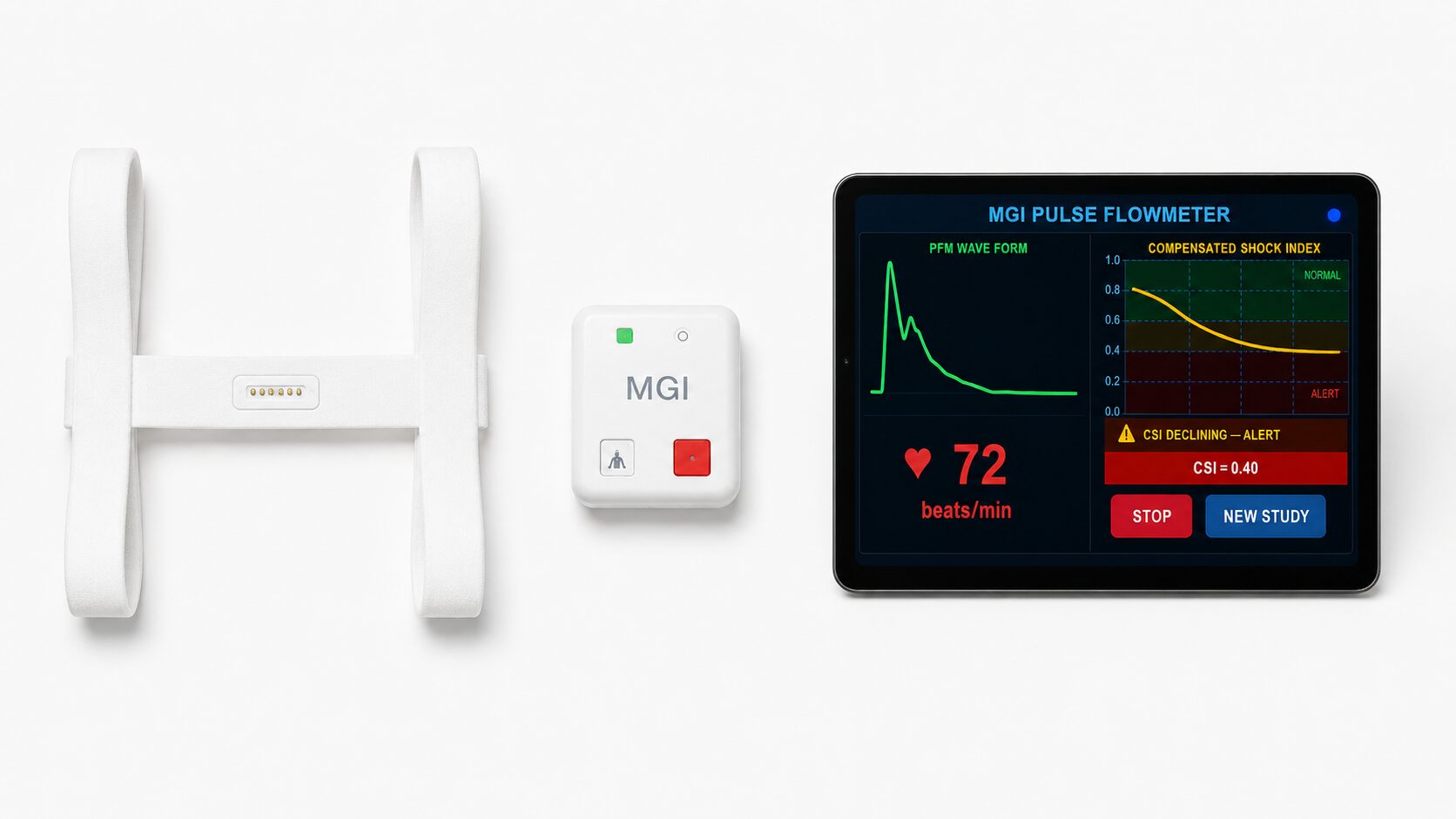
Concept visualization: Electrode, Hub and Monitor. Commercial design in development.
Early human evidence supports the signal. The next step is disciplined clinical and regulatory execution.
The founders have invested approximately $2 million to date. With that internal funding, they created the technology and demonstrated that it works in early human clinical trials.
Clinical Study at Mayo Clinic
In a recent study, the PFM correctly identified the presence or absence of occult bleeding in 12 of 12 patients who presented with GI bleeding in the emergency department. The manuscript is under review for publication in a peer-reviewed journal.
Blood-donor study
PFM technology demonstrated that it could detect the loss of a single pint of blood (1 unit). Blood pressure does not begin to drop until the patient has lost about 40% of blood volume and is close to heart failure.
Commercial product development
The technology has been created, so the inventing is largely complete. Current work is focused on creating the first commercial version of the PFM and executing the regulatory pathway for the initial indication. After the first product is launched, MGI plans additional clinical studies for expanded indications.
Milestones to Date
✓ Patented technology created
✓ Prototype developed
✓ Early human studies completed
✓ Commercial architecture defined
Three short videos. Three important perspectives.
Give investors a quick way to understand where the technology came from, how the system works, and why the clinical opportunity matters.
HOW MGI CAME TO BE
Dr. Lloyd Marks shares the clinical insight, engineering journey, and purpose behind MGI Medical’s Pulse FlowMeter technology.
THE SYSTEM IN ACTION
A concise demonstration of the Electrode, Hub, and Monitor working together to continuously measure and display Pulse Flow.
INTERVIEW WITH DR. ANDREW STORM
A clinical perspective from the lead investigator of the Mayo Clinic study. In that study, the PFM correctly identified the presence or absence of occult bleeding in 12 of 12 patients who presented with GI bleeding in the emergency department.
A differentiated technology with meaningful early de-risking.
Patented Technology
Proprietary Pulse FlowMeter technology and a distinct physiologic parameter: Pulse Flow.
Early Human Evidence
Blood-donor and Mayo Clinic feasibility work support the signal and initial clinical thesis.
Experienced Leadership
Medical-device invention, engineering, FDA, financing, commercialization, and exit experience.
Scalable Model
Disposable Electrode utilization, reusable Hub deployment, and recurring Monitor software.
The PFM addresses a universal clinical need across acute care settings.
A platform designed for clinical value—and a scalable recurring model. Initial target markets include emergency rooms, ICUs, and postoperative recovery units. In the United States alone, there are more than 5,000 hospitals, 9,000 ambulatory surgical centers, and 1,200 postoperative rehabilitation centers—each potentially requiring multiple PFM Systems. Post-discharge home monitoring represents a compelling adjacent market.
Disposable Electrode
Patient-contact component used during monitoring.
Recurring utilization
Reusable Hub
Durable signal-acquisition and communications hardware deployed at the point of care.
Installed hardware
Software Monitor
Displays Pulse Flow trends and supports future software and analytics capabilities.
Recurring license

Built by a team that understands invention, medical devices, and commercialization.
Experienced medical-device leaders spanning invention, engineering, regulatory execution, financing, and commercialization.

Founder, Inventor & Chairman
Pediatric cardiologist and instrumentation engineer; inventor of PFM technology. Holds 27 issued medical-device patents. BS Electrical Engineering, MIT; MD, University of Michigan; MBA, University of Tennessee.

Chief Executive Officer
Thirty years of medical-device executive leadership. Has led five medical-device start-ups, raised more than $25 million, supported successful exits, and managed more than 50 FDA 510(k) clearances. BS Microbiology, Michigan State University; MBA, University of Michigan.

Chief Technical Officer
Twenty-four years in the medical-device industry. Director of Engineering at General Devices and designer of the first commercial city-wide wireless EMS telemedicine system in the United States. BS Electrical Engineering, Rutgers University.

Founding Partner
CEO & Protagonist of Responsive Innovation at General Devices, a HealthTech company. His 40 years of experience includes developing and marketing medical devices, communications and telehealth solutions deployed in major hospital systems across the US. He holds a BSEE and MS in Biomedical Engineering from New Jersey Institute of Technology.

Founding Partner
Chief Software Officer at General Devices with over 30 years of experience in the medical device industry leading software teams. He received his BS and MS in electrical engineering from the University of Science and Technology and received his Ph.D. in Biomedical Engineering at Rutgers University.
Advancing from promising evidence to a regulated commercial product.
MGI Medical is conducting an initial financing round to create the first commercial version of the PFM, conduct the regulatory work to obtain its first FDA 510(k), and build the initial infrastructure to market a commercial medical device.
✓Complete product engineering
Advance design-for-manufacture and connected-system development.
✓Conduct physician market research
Ensure the design meets the needs of anesthesiologists, cardiologists, gastroenterologists, surgeons, and emergency physicians.
✓Advance FDA submission activities
Execute the regulatory plan with disciplined design controls and documentation.
✓Prepare for commercialization
Develop quality, manufacturing, and go-to-market foundations.
REQUEST INVESTOR INFORMATION
Request Investor Information
